By the numbers

The Issue

Forever chemicals, woven in.

The clothes we wear every day are made with chemicals designed never to break down. Here is what they are, what they do, and who carries the cost.

The industry

Fashion runs on chemicals

Fashion is one of the most polluting industries on earth. It runs on chemicals at every step, using about 0.58 kilograms of chemicals for every kilogram of fabric made.1 Dyes give clothes their color. Finishes keep them from wrinkling. Coatings make them repel water and stains. Textile manufacturing produces roughly a fifth of the world's industrial water pollution, and dyeing is the single largest chemical polluter of that water.2

Because fashion's supply chain is so complex, transparency has always been a problem in this industry, and that makes it hard to track chemicals through it. Only a handful of major brands publicly disclose the chemicals in their supply chains.2
The chemical

What is PFAS?

PFAS stands for per- and polyfluoroalkyl substances, a family of roughly 12,000 synthetic chemicals.1 In clothing, they create the finishes sold as "performance" or "weatherproof": the ones that shrug off water, stains, and grease.34 People call them forever chemicals for a reason. The same bond that makes them so durable means they barely break down. They persist for years, in water, in soil, in the human body.

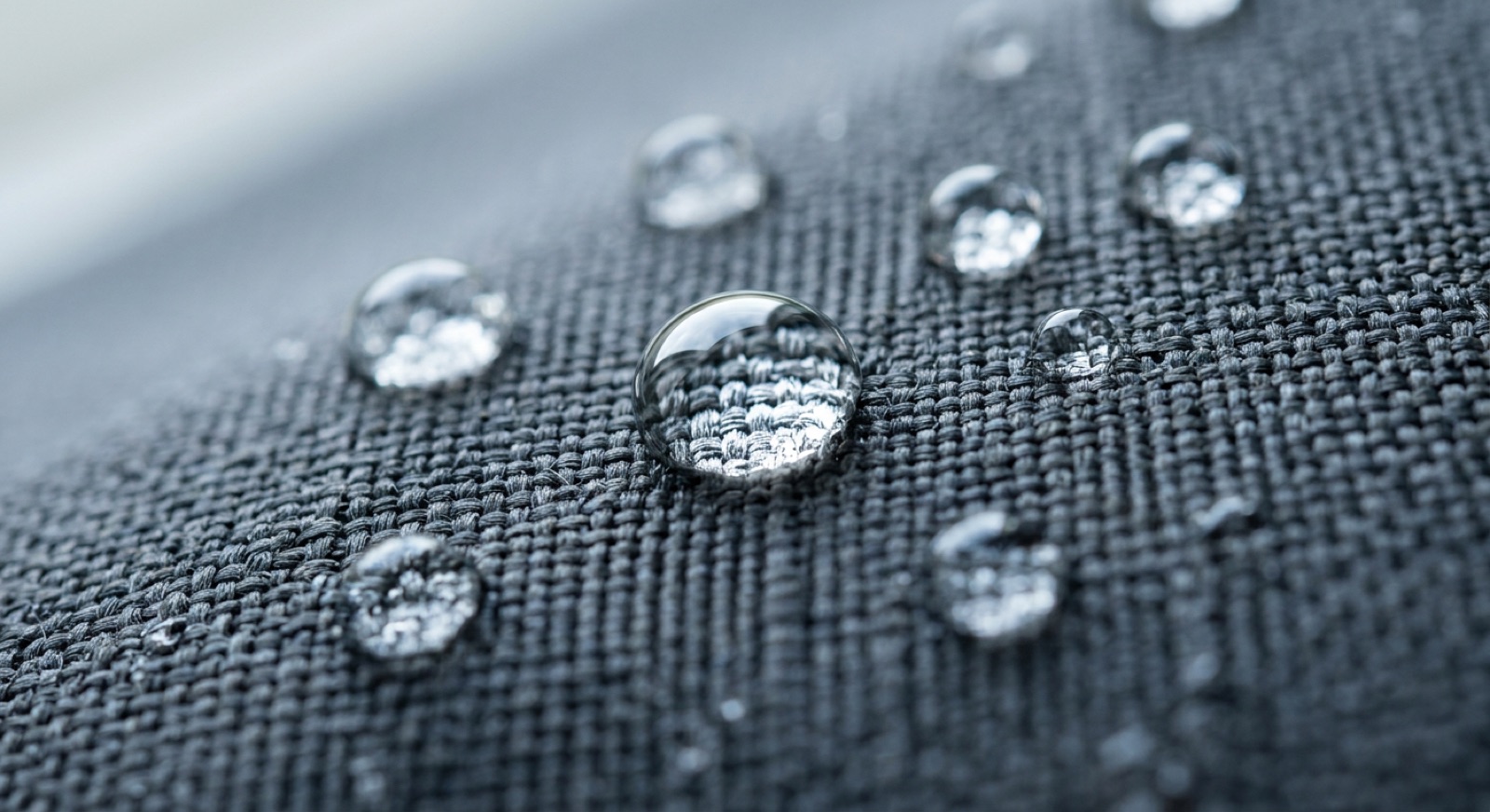
Water droplets beading on the surface of a woven fabric treated with a water-repellent finish.
Water beading on a treated "performance" fabric

The harm

What PFAS does

Overall health impacts

PFAS rarely travels alone. It often shows up with bisphenol A, phthalates, and heavy metals. Together, these chemicals are endocrine disruptors. They interfere with the hormones that regulate reproduction. Exposure has been linked to infertility, reduced fertility, higher-risk pregnancies, and some cancers.567 Others have been tied to skin irritation and allergic reactions from the chemicals worn against the body.8

For consumers

Chemicals in textiles can pass through the skin.9 And clothing sits against our skin for most of the day. The result is a low, constant exposure, one most people never know they're carrying.

For garment workers

Garment workers meet these chemicals first, and in far higher doses. They breathe cotton dust, dye fumes, and pesticide residue for entire shifts, often with no protective gear. Studies link this exposure to respiratory disease, weakened immune function, and asthma.10

Why this matters

Who is exposed, and who can avoid it.

This is not only a health story. It is also a story about who is exposed and who can avoid it. Safer clothing costs more, and the people most reliant on cheap fast fashion are often the least able to pay for an alternative, or to reach care when exposure becomes harm. The same chemicals fall hardest on the garment workers who handle them at the source. Race, class, and gender mark both ends of the chain.

The scale of the problem

Fashion by the numbers

0.58kg

of chemicals go into every kilogram of fabric made1

12,000PFAS

synthetic "forever chemicals" make up the PFAS family1

80brands

pledged to eliminate hazardous chemicals — about 15% of global clothing production12

57brands

actively implement the ZDHC chemical-management guidelines13

7%

of the 250 biggest brands disclose their wastewater test results11

6%

of the 250 biggest brands publicly commit to phasing out hazardous chemicals11

Sources

  1. UN Environment Programme. (2022). Textile-producing nations unite to reduce chemical waste [Press release]. unep.org
  2. Green America. (2019). Toxic Textiles: The chemicals in our clothing. greenamerica.org
  3. Glüge, J., Scheringer, M., Cousins, I. T., DeWitt, J. C., Goldenman, G., Herzke, D., Lohmann, R., Ng, C. A., Trier, X., & Wang, Z. (2020). An overview of the uses of per- and polyfluoroalkyl substances (PFAS). Environmental Science: Processes & Impacts, 22(12), 2345–2373. doi.org/10.1039/D0EM00291G
  4. Schellenberger, S., Hill, P. J., Levenstam, O., Gillgard, P., Cousins, I. T., Taylor, M., & Blackburn, R. S. (2019). Highly fluorinated chemicals in functional textiles can be replaced by re-evaluating liquid repellency and end-user requirements. Journal of Cleaner Production, 217, 134–143. doi.org/10.1016/j.jclepro.2019.01.160
  5. Cohen, N. J., Yao, M., Midya, V., et al. (2023). Exposure to perfluoroalkyl substances and women's fertility outcomes in a Singaporean population-based preconception cohort. Science of the Total Environment, 873, 162267. doi.org/10.1016/j.scitotenv.2023.162267
  6. Karwacka, A., Zamkowska, D., Radwan, M., & Jurewicz, J. (2019). Exposure to modern, widespread environmental endocrine disrupting chemicals and their effect on the reproductive potential of women. Human Fertility, 22(1), 2–25. doi.org/10.1080/14647273.2017.1358828
  7. Qu, R., Wang, J., Li, X., Zhang, Y., Yin, T., & Yang, P. (2024). Per- and polyfluoroalkyl substances (PFAS) affect female reproductive health: Epidemiological evidence and underlying mechanisms. Toxics, 12(9), 678. doi.org/10.3390/toxics12090678
  8. International Labour Organization. (2021). Exposure to hazardous chemicals at work and resulting health impacts: A global review. ilo.org
  9. Iadaresta, F., Manniello, M. D., Östman, C., Crescenzi, C., Holmbäck, J., & Russo, P. (2018). Chemicals from textiles to skin: an in vitro permeation study of benzothiazole. Environmental Science and Pollution Research, 25(25), 24629–24638. doi.org/10.1007/s11356-018-2448-6
  10. Seidu, R. K., Ofori, E. A., Eghan, B., Fobiri, G. K., Afriyie, A. O., & Acquaye, R. (2024). A systematic review of work-related health problems of factory workers in the textile and fashion industry. Journal of Occupational Health, 66(1), uiae007. doi.org/10.1093/joccuh/uiae007
  11. Fashion Revolution. (2023). Fashion Transparency Index 2023. fashionrevolution.org
  12. Greenpeace. (2018). Destination Zero: Seven years of Detoxing the clothing industry. greenpeace.org
  13. Zero Discharge of Hazardous Chemicals (ZDHC). (2024). Roadmap to Zero: Impact Report 2024. roadmaptozero.com